Label facts
Lymph Flow Supplement Facts and Label Details
This page would normally transcribe a Supplement Facts panel row by row. There is no panel to transcribe. What follows instead is an account of what a label is required to carry, what this one carries, and what can honestly be derived from the single quantity that exists.
Lymph Flow lists a 600 mg proprietary blend per two-dropper serving.
That blend is shared by six named ingredients, with no amount given for each. A full Supplement Facts panel is not printed on the bottle artwork.
The five statements a label must carry
“Five statements are required: 1) the statement of identity (name of the dietary supplement), 2) the net quantity of contents statement (amount of the dietary supplement), 3) the nutrition labeling, 4) the ingredient list, and 5) the name and place of business of the manufacturer, packer, or distributor.”
U.S. Food and Drug Administration — Dietary Supplement Labeling Guide: Chapter I. General Dietary Supplement Labeling
| Required statement | Supplied? | What was supplied |
|---|---|---|
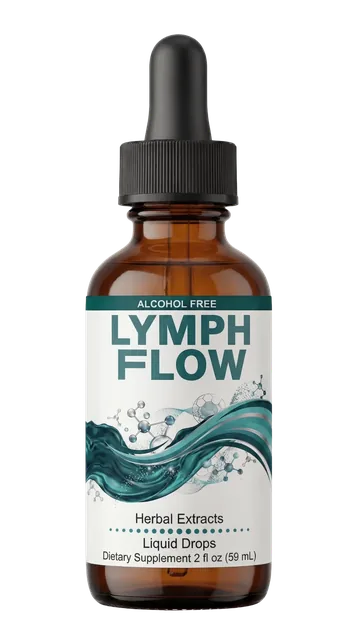
| Statement of identity | Yes | The front of the bottle reads LYMPH FLOW and Dietary Supplement. |
| Net quantity of contents | Yes | The front of the bottle reads 2 fl oz (59 mL). |
| Nutrition labeling | No | No Supplement Facts panel appears on any image, graphic or document supplied with this product. The one quantity that exists anywhere — 600 mg of blend per serving — is printed in a marketing graphic, not on a label. |
| The ingredient list | Partly | Six ingredients are named, but in the marketing rather than on the bottle: boswellia serrata, curcumin, horse chestnut, gotu kola, quercetin phytosome and ginger extract. No amount, no plant part, no standardisation and no Other Ingredients line accompanies any of them. |
| Name and place of business | No | No manufacturer, packer or distributor is named on the product. The retail desk’s own New York addresses are published on this site, and they are not the same thing. |
Statements one and two are printed large, on the face of the bottle, where a buyer is being persuaded. Statements three, four and five are the ones normally printed small, on the information panel, where a buyer goes to decide. That is the shape of this product’s disclosure in a sentence.
The one number, and where it lives
Everything quantitative known about this product is one sentence, and it is not on a label. The graphic headed How Lymph Flow Works reads: “Each 2-dropper serving delivers 600 mg of our proprietary blend”. The sentence continues “a careful mix of ancient herbs and” and then stops.

It is worth being exact about why the location of that figure changes what can be done with it. A quantity on a Supplement Facts panel sits inside a structure the FDA defines: the blend’s total weight must be declared, and its ingredients must be listed “in descending order of predominance by weight”. That second requirement is what converts an undisclosed blend into six arithmetic ceilings on every other product this desk has covered.
A quantity in a marketing graphic carries none of that. The 600 mg may well be accurate — nothing here suggests otherwise — but the six names beside it are in whatever order the designer chose. That is the whole of the difference, and it is the reason every ceiling on this site is printed with the word if in front of it.
The conditional ceilings
Every bar here is conditional. The FDA’s descending-order rule applies to the Supplement Facts panel, and this product has no panel. The order used above is the order the marketing graphic and the seller pack happen to print the six names in. If that is also the weight order, the ceilings are 600 mg divided by each position. If it is not, the bars mean nothing. On every other product this desk covers the rule can be leaned on; here it cannot, which is why the chart is drawn with the caveat attached rather than in a footnote.
One answer from the order desk would settle it: are the six ingredients listed in descending order of weight? If yes, every bar above becomes a fact. If no, they all disappear and this product publishes nothing quantitative about any individual ingredient at all.
Boswellia’s best case
The amber bar is a ceiling on a ceiling. Boswellia is listed first of six, so on the conditional reading it cannot exceed the blend total of 600 mg — and reaching that figure would require the other five ingredients to be absent entirely. The real amount is lower, and nothing published says by how much. The reference bars are NCCIH’s: it records “doses up to 1,000 mg daily… safely used in several clinical trials lasting up to 6 months” and use “at a dose of 2,400 mg for up to 1 month”. Its verdict on all of it: “there is not enough high-quality evidence to determine whether boswellia is useful for any health condition”.
That amber bar is generous twice over. It assumes the marketing order is the weight order, and it assumes boswellia is the entire blend — 600 mg with nothing left for curcumin, horse chestnut, gotu kola, quercetin or ginger. On both assumptions at once it still sits below the range NCCIH records as studied.
The fair conclusion is not “this will not work”. NCCIH’s summary of the whole boswellia literature, at any dose, is that “there is not enough high-quality evidence to determine whether boswellia is useful for any health condition”. So the comparison is between a small amount and a set of trials that did not settle the question at amounts several times larger. The full row is on the ingredients page.
The horse chestnut question
This is the most important paragraph on this site, and it is made of two consecutive sentences from one public source.
“The raw seeds, bark, flowers, and leaves of horse chestnut are unsafe when used orally because they contain a toxic component. Standardized horse chestnut seed extracts, from which this component has been removed, are likely safe for short-term use and have been used safely in research studies for up to 12 weeks.”
NCCIH — Horse Chestnut: Usefulness and Safety
Everything separating unsafe when used orally from likely safe lives in three words: standardized, seed, extract. This product prints “Horse Chestnut”. There is no plant part. There is no statement that it is an extract. There is no standardisation. And because there is no Supplement Facts panel, there is no second document to check.
| Detail | What we were actually given |
|---|---|
| Plant part | Not printed. NCCIH names seeds, bark, flowers and leaves as the raw materials that are unsafe orally; only the seed appears in the safe form. |
| Whether it is an extract | Not printed. The word extract appears for the ginger row and not for this one. |
| Whether it is standardised | Not printed. This is the word NCCIH uses to describe the form from which the toxic component has been removed. |
| The amount | Not printed. Conditionally at most 200 mg, third of six. |
| On the Supplement Facts panel | There is no panel. |
What this site is and is not saying
It is not saying this product contains the unsafe form. There is no evidence for that, and implying it would be exactly the kind of thing this site exists to avoid. It is saying that the single distinction the relevant public body draws between a preparation it calls unsafe and one it calls likely safe is a distinction this product does not make anywhere — and that a buyer who wants to check it has nowhere to look. It is the first question on the call script, and one sentence from the seller would answer it.
What, exactly, is a dropper?
The directions read: “Shake well. Mix one serving (2 droppers) into a glass of water or juice once daily, or as directed by your healthcare professional.” That instruction is complete in every respect except the one that decides the dose.
| If one dropper delivers… | …because | A serving is | Servings in a 59 mL bottle | Blend per millilitre |
|---|---|---|---|---|
| 0.6 mL | a light squeeze of a 1 mL pipette | 1.2 mL | about 49 | about 500 mg |
| 0.75 mL | a typical single squeeze | 1.5 mL | about 39 | about 400 mg |
| 0.9 mL | a firm squeeze | 1.8 mL | about 33 | about 333 mg |
| 1.0 mL | a pipette filled to the mark | 2.0 mL | about 30 | about 300 mg |
Two consequences. The first is practical: a bottle lasts between about 30 and 49 days, and the 60-day money-back window runs from purchase, so where a bottle lands in that range decides whether it finishes inside the window.
The second is the last column. The same 600 mg in less liquid means a higher concentration, so across the range the bottle implies roughly 300 to 500 milligrams of blend in every millilitre — about 30% to 50% by weight per volume.
Why that column is a question rather than a conclusion
It is a high loading for any liquid, and three supplied facts bear on it. The bottle is labelled ALCOHOL FREE. NCCIH describes boswellia as “an herbal extract made from the gum resin or bark of the tree”, and gum resins are poorly soluble in water, which is the usual reason such preparations are made with ethanol. And the directions begin “Shake well”, which on a liquid normally indicates that the contents settle — that is, that material is suspended rather than dissolved. Nothing supplied names the carrier, the solvent or any excipient, so none of this resolves here. It is the fourth question on the call script.
Everything the bottle says
Transcribed in full. This is not an excerpt.
| Detail | What we were actually given |
|---|---|
| Front panel | ALCOHOL FREE · LYMPH FLOW · Herbal Extracts · Liquid Drops · Dietary Supplement 2 fl oz (59 mL) |
| Suggested use | Not on the bottle. The directions quoted on this site come from the seller pack and the marketing graphic. |
| Supplement Facts panel | None. |
| Ingredient list | Not on the bottle. Six names appear in marketing artwork only. |
| Other ingredients | Not published. No Other Ingredients line was supplied, and no carrier, solvent, preservative or sweetener is named anywhere — on a liquid. |
| Allergen statement | Not printed. |
| Caution or warning | Not printed. No caution or warning block appears on the bottle artwork or on any graphic supplied with this product. |
| Storage | Not printed on anything supplied. |
| Distributed by | Not printed. No manufacturer, packer or distributor appears on the product. |
| Country of manufacture | Not printed. No country of manufacture appears on the bottle artwork supplied. |
| FDA statement | Printed on the marketing graphic, not on the bottle: “These statements have not been evaluated by the Food and Drug Administration. This product is not intended to diagnose, treat, cure or prevent any disease.” |
Five of those eleven rows read not printed or none, and two more point at marketing artwork rather than at the product. The bottle carries a brand, a product descriptor, a net quantity and the words alcohol free. That is the complete label.
The ten marks
Ten marks were supplied alongside this product. Not one of them is printed on the bottle artwork itself, none names a certifying body or carries a registration number, and every one of them is a pixel-for-pixel match for a file supplied with three other, unrelated brands. Eight are shown below; two are not published on this site, and the reasons follow.


The shared badge set
This desk compared each of the ten marks against the asset folders of every other product received in the same run, by downsampling both images to 64×64 pixels and measuring the mean absolute difference per colour channel. A difference of zero means the files are the same image. Ten of ten matched Lungora, a lung supplement. Ten of ten matched Slim Metrix, a weight-loss supplement. Nine of ten matched Zencortex, an ear-health supplement. The payment-card strip matched as well. The mean difference on every one of those matches was 0.00.

The two that are not shown
The “made in USA” roundel is misprinted. Its ring reads MANUFACTURE IN around the top and MANUFACTURE IN around the bottom. The phrase is ungrammatical, it is duplicated, and it never finishes — the word USA appears only in the centre device, not in the sentence. A mark that cannot spell its own claim is not evidence of anything, and this site does not reproduce it as a trust signal.
The “Doctor Formulated” badge names no doctor. No name, no credential, no registration number and no statement of what the doctor is supposed to have done. This desk does not publish a practitioner endorsement without a practitioner, and it does not invent one. That file, too, is shared with all three other brands.
Worth repeating on its own line: not one of the ten marks is printed on the bottle artwork. Every one of them lives in the marketing folder. A mark that appears in a sales asset but not on the product is a claim made by the seller rather than by the label. The seals page sets out what each of the eight published marks is a claim about.
Twelve findings, in full
Each is a statement about this product, checked against a source linked at the foot of the page. They are ordered by how much they should change a decision.
01There is no Supplement Facts panel. Two of the FDA’s five required statements are supplied in full.
02The only quantity that exists is one sentence in a marketing graphic.
03Because there is no panel, even the usual ceilings cannot be relied on.
04Even the most generous reading puts the largest ingredient below the studied dose.
05“Horse Chestnut” names no plant part, no extract and no standardisation — and that is the distinction that decides its safety.
06“Two droppers” is not a measurement, so neither the dose volume nor how long a bottle lasts can be worked out.
07The same arithmetic implies a concentration between about 300 and 500 milligrams per millilitre.
08Two of the six ingredients have no monograph at the bodies this desk reads.
09None of the six has a lymphatic monograph, and lymphoedema is a condition with real management.
10Every mark supplied with this product is a pixel-for-pixel match for a file supplied with three other brands.
11Six generated portraits, a physician badge naming no physician, and a pack that calls its own reviews layout copy.
12Three of the four captions in the marketing graphic are cut off mid-sentence, and the order desk is shared with another brand.
References
Every source below was opened and read. Where a quotation appears on this page, it is copied from the page linked here.
- U.S. Food and Drug Administration (2026). Dietary Supplement Labeling Guide: Chapter I. General Dietary Supplement Labeling.
- U.S. Food and Drug Administration (2026). Dietary Supplement Labeling Guide: Chapter IV. Nutrition Labeling.
- National Center for Complementary and Integrative Health (2025). Horse Chestnut: Usefulness and Safety.
- National Center for Complementary and Integrative Health (2025). Boswellia: Usefulness and Safety.
- National Center for Complementary and Integrative Health (2025). Turmeric: Usefulness and Safety.
- National Center for Complementary and Integrative Health (2025). Ginger: Usefulness and Safety.
- National Center for Complementary and Integrative Health (2026). Herbs at a Glance: A-to-Z index.
- National Cancer Institute (2024). Lymphedema and Cancer.
- National Center for Complementary and Integrative Health (2025). Detoxes and Cleanses: What You Need To Know.
- U.S. Food and Drug Administration (2026). Questions and Answers on Dietary Supplements.
Ask for the panel, and ask about the horse chestnut
A 2 fl oz bottle of liquid drops, two droppers a day, and no Supplement Facts panel on anything supplied with it. The only quantity that exists — 600 mg of blend a serving — is printed in a marketing graphic. No price was supplied either; the live figure and the 60-day return terms are on the seller’s checkout screen.
60-day window · Questions first? Call +1 (302) 200-3480